




This is how you take collagen powder, seriously: dose, timing & sanity checks
Collagen. How do you take yours? It’s not as simple as aiming for the perfect sugary gloop-to-melted-chocolate ratio. On planet collagen, there are a gazillion TikTok videos schooling us on recipes and rare blends of collagen coffee, collagen smoothies, and water-based collagen hydration rituals. Then there are creams and oils. Or liquids, sachets, gummies, tablets, capsules, powder. Feeling overwhelmed?
We’re not fans of over-info-influencing either. We are, however, megafans of plain talking and correct information. So here is the practical stuff: how much to take, when to take it, how to mix it, and how to get the most out of it.
FYI. We’re talking collagen powders here not capsules, gummies or tablets because they’re the most effective form for absorption, less likely to contain anything grim, and also allow you to control the dose, for your body and your purse strings. (Unless you’re looking at topical, and oils for your skin to provide you with targeted collagen support. Which we’d recommend taking together with a powder.)
N.B. If an ASMR voice is how you best take in info. We’re totally doing one.
What is collagen & why take it?
What even is collagen? Let’s go top-level: it’s the stuff that helps keep the house standing. The foundations. The walls. The bricks and mortar. Your body already uses collagen in the connective tissues of your skin, cartilage and joints. As we age, we make less of it. People fixate on what that means for our skin (oh, the sag), but it also affects our muscles, joints, and bones, too (oh, the pain). Supplementing with collagen provides the amino acids your body uses to support its own collagen production.
For those who like to really know a thing, we’ve gone deep about what it is in our ultimate guide to collagen.
Is there a ‘best way’ to take collagen powder?
The ‘best way’, is your way.
Once you’ve figured out which collagen you’re going for (don’t worry, we have a blog for choosing the right collagen, without losing your mind), whether it’s marine or bovine collagen will likely impact your dosage. The general rules (there are three).
- Ask yourself what you are taking it for, skin, performance or for long-term mobility?
- Start slow and listen to your body
- Make sure it aligns with your budget, lifestyle, diet and maybe even ethics.
How much do I need?
Much like our bodies, the science of dosing collagen needs to be a bit bendy. The dose best suited to you, will be exactly that: personal, and dependent on how your body responds. When it comes to marine and bovine collagen, we recommend slightly different amounts, based on a mix of customer feedback and the available research.
With our Skinful marine collagen, we recommend starting at 5g a day. When we first launched Skinful, the manufacturer suggested 5g to 10g a day. But after a few months we received lots of feedback from customers, retailers and nutritional therapists who felt (and saw) the benefits at just 5g. We also got a bit in our heads about the idea of us accidentally encouraging people to use more, because they might think that came from us wanting to sell more, so we changed the label to 5g . That means one of our pots of Skinful will last you 2 months.
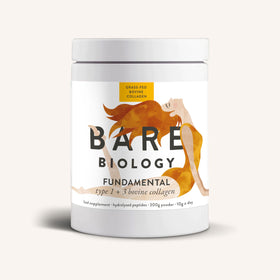
For our Fundamental bovine collagen, we recommend about 10g a day. In studies looking at collagen for tendons and load-bearing connective tissue, higher daily dosages are typically used than in skin-focused studies (which often see effects at around 5g). Because Fundamental is intended as a whole body collagen to support the connective tissue like tendons and ligaments, 10g sits in the middle of the range commonly used in studies showing benefits in this area. That’s four rounded teaspoons. So we’ve put 10g on the label for Fundamental to offer a high-impact dose that’s still affordable for regular use. If you're looking to support post-exercise recovery or wound healing, some studies use higher intakes (around 20 to 30g a day).
The amount you should take is highly personal depending on health, and metabolism, so it’s best to consult a Nutritional Therapist if you have any specific concerns. For most people though, how much collagen you take will depend on your reason for taking it, and what fits your routine and your budget.
How to make collagen work for you: consistency > timing
Lots of people ask us for hacks on the most effective way to take collagen. Whether it’s better to take on an empty stomach, with food, or at a specific time of day. Here’s what we know.
Right now, there’s not enough research to suggest that the bioavailability of collagen changes depending on whether the stomach is full or empty. Hydrolysed collagen is made up of peptides (partially broken down proteins) which are absorbed into the blood stream via the small intestine, much like any other protein. In theory, having a full or empty stomach shouldn't make any difference.
Having said that, because we've had feedback from customers who struggle with sensitive digestion and bloating when they take collagen on an empty stomach, we feel it's sensible to advise against this. But we're all different and for most people, it shouldn't be a problem whenever it's taken
When it comes to timing, consistency is the only thing we’d really recommend. You’re the boss of when. Just make it work with your routine and try to stick to it. That’s the bit that makes the difference. We’ve tested out loads of tips to help the habit stick and the one that never fails us is stacking collagen with something you already do. Bung it in your morning coffee, or rattle it around in your post-workout shake. Our advice is to make collagen fit into your life, not the other way round.
Can I take Creatine and Collagen together?
Absolutely. They complement each other well through different mechanisms, supporting the body and brain through perimenopause, intense training, or just a busy life.
Collagen is a structural protein that supports connective tissues in the body, including skin, joints, tendons, ligaments and bone. It provides amino acids like glycine, proline and hydroxyproline, which are excellent for bone, joint and gut health. Hydroxyproline encourages repair and stimulates the body’s own collagen production. You can read more about what these amino acids do in our ultimate guide to collagen.
Creatine, on the other hand, is a compound made from three amino acids: glycine, arginine, and methionine. The most effective forms of creatine, such as creatine monohydrate, like our High Flyer, have been well studied because of their role in the body in helping regenerate ATP, the molecule that cells use for energy. This is why creatine is well known for improving strength and exercise performance, with emerging research suggesting benefits for cognitive health too. Read all about why creatine is good for women in our guide.
Taken together, they support busy bodies and brains. They’ll really help anyone who’s dealing with testing times or proactively testing their mettle. If you're new to either supplement, we'd recommend starting slow and staying well hydrated.